






As part of its longstanding commitment to corporate social responsibility and its role in supporting the healthcare sector and promoting sustainable development, Bank of Jordan has provided support to the National Newborn Hearing Screening Program implemented in maternity departments across government hospitals. The program is carried out by Think Palestine Association in partnership with the Palestinian Ministry of Health.
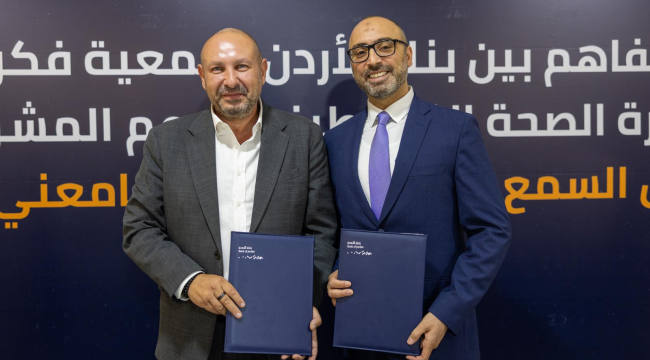
The support agreement was signed by Mr. Saif Issa, Chief Executive Officer of Bank of Jordan's Palestine Branches, and Mr. Tareq Arouri, President of Think Palestine Association, under the patronage of H.E. Dr. Majed Abu Ramadan, Minister of Health, and H.E. Dr. Laila Ghannam, Governor of Ramallah and Al-Bireh.
The Bank's contribution includes the purchase of seven advanced newborn hearing screening devices, with a total value of USD 70,000, in response to one of the program's key components: equipping government hospitals with modern screening technology integrated into routine newborn healthcare services. The initiative aims to ensure the early detection of hearing impairment or hearing loss, improve opportunities for timely medical intervention, and reduce long-term language and cognitive complications.
Dr. Majed Abu Ramadan stated: "Investing in the health of Palestinian children is an investment in the survival of our people, in their future, and in their resilience. At the Ministry of Health, we will remain open to every meaningful partnership that serves our people, and we will work to ensure that this program, along with other preventive healthcare initiatives, reaches every hospital and every child across Palestine—from Jenin to Rafah."
He thanked Bank of Jordan, Think Palestine Association, and the Ministry of Health's staff for their collective efforts, adding: "Let us remain one voice for the health of our children and the future of Palestine."
For her part, Dr. Laila Ghannam emphasized the importance of this national initiative in supporting the wellbeing of Palestinian children and expressed her appreciation for the national and community role played by Bank of Jordan through its corporate social responsibility initiatives and its support for healthcare programs that serve the Palestinian people and strengthen the resilience of national institutions.
Mr. Saif Issa said: "Our support for this national program reflects Bank of Jordan's belief that investing in children's health is an investment in the future of Palestinian society and a contribution to providing children with better opportunities to grow, learn, and fully participate in their communities."
He added: "We are proud of our partnership with the Ministry of Health and Think Palestine Association in this humanitarian initiative, which represents a successful model of cooperation between the banking sector and healthcare and community institutions to achieve sustainable development impact. We hope this support will strengthen early detection services and positively improve the quality of life of children and their families."
Issa also affirmed that Bank of Jordan remains committed to implementing its corporate social responsibility programs in line with its vision of placing people at the heart of its priorities, while supporting initiatives with lasting impact in the fields of healthcare, education, and economic empowerment, thereby contributing to sustainable development and serving the Palestinian community.
Mr. Tareq Arouri, President of Think Palestine Association, stated that this partnership represents an important step toward expanding services for children and ensuring the sustainability of health and educational initiatives that address their needs, particularly under the current circumstances.
Think Palestine Association brings together a distinguished group of professionals and specialists who volunteer their expertise to implement humanitarian and development initiatives aimed at serving Palestinian society and enhancing quality of life.
Bank of Jordan was among the first financial institutions to establish operations in Palestine following 1994. Since then, it has played a leading role in delivering high-quality banking services to a broad range of sectors while contributing to the development of the local economy and supporting communities through its ongoing humanitarian, relief, and development initiatives.


 About BOJ
 Contact BOJ
 Find BOJ